
Take a look at our Portfolio!

How To Conduct Your Own Keyword Research

Keyword research is fundamental to search engine optimisation, in many ways, it’s the foundation of all marketing funnels – searches are expressions of what people are looking for. So, when researching keywords, what you need to be thinking about is providing the answers to what searchers are looking for. Google’s algorithm is constantly working on this very thing and good search engine optimisation reflects this.
Size doesn’t matter!
When optimising for keywords, you need to be considering that it’s not always the highest volume search terms that are going to be best for business. Ultimately what you need to consider is, do these keywords show intent, infer user engagement in my services or products, and are they likely to go on to make a purchase or enquiry.
The basics
Build a keyword list that includes short tail and long tail keywords that are informative, commercial and transactional.
- Informative keywords - e.g. what is SEO, how do I do my own keyword research, why does SEO improve organic rankings
- Commercial – comparative searches e.g “best”, “vs” (For example, “best printers”)
- Transactional – Confers more purchase intent e.g “buy”, “cheap”, “download”
Each of these keyword categories represent a step in the buyer’s purchasing cycle. Eventually consumers will reach the transactional stage, whereby they are showing intent of converting.
Begin with broad relevant topics
Start by brainstorming the topics you want your business to rank for on the SERP’s. Think of these as important umbrella terms, in which you can then develop more specific keywords for later.

If you’re struggling, it may help to envisage yourself as a customer. What would they be searching for to do with my business or industry? What information would they want to be provided with? If you were a full-service agency such as us, you may have broad topics such as ‘SEO’, ‘Web Design’, ‘PPC’ and ‘Website development’. These keywords are called short-tail keywords, or seed keywords.
After you’ve come up with these terms, you could use a tool such as Keyword planner to determine estimated average monthly volume. By providing yourself with this data it allows you to determine how important these topics are to your consumers, as well as which topics you should focus on producing specific keywords for.
Producing specific keywords
Now that you’ve identified your short tail keywords, now is the time to develop those to create long-tail keywords that use a combination of modifiers. These will be keywords (or searches) you expect your target audience to be searching for.
Let’s look at ‘SEO’ related long tail keywords Potential keywords related to this topic could be:
- What is SEO?
- SEO tools
- On-site SEO
- What is technical SEO?
- Black Hat VS Whit Hat SEO
Common informative modifiers include:
- What
- Why
- How
- Which
- Where
Common intent modifiers include:
- Buy
- Price
- Cheap
- Affordable
- Download
- Book
- Quote
- Discount
- Deals
A use for keyword planner is for the creation of potential keywords for your business. This application is especially useful after you’ve brainstormed some keywords yourself, as it can highlight any keywords you may have missed.
Alongside keyword planner, semantically related keywords can be found by doing some physical google searches yourself. By browsing the ‘people also ask’ section, as well as the ‘searches related to’ section at the bottom of the SERP, you’re able to grow your list of similar keywords.
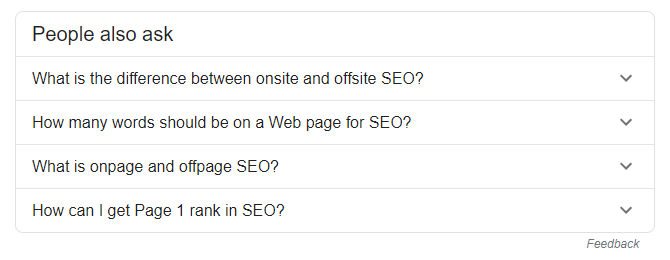
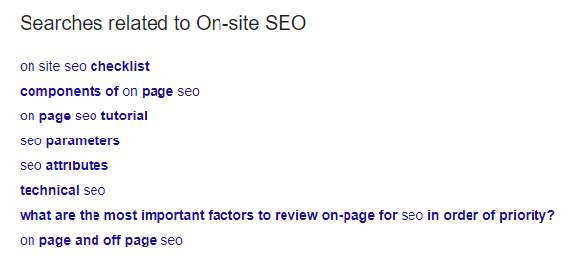
Applying the search modifiers that we spoke of earlier to your keywords is another sure-fire way of throwing up new keywords. These keywords are likely to be closer to search queries than your previous keywords. Being long tail, it’s probable that they will have low search volume. However, this is more than made up by the higher conversion rate you often see paired with them.
Poaching competitor keywords

Spying on your competitors is common practise when it comes to SEO and it’s no different when it comes to keyword research. If you’re not monitoring the keywords your competitors are ranking for, you’re missing out on a great opportunity to improve your own rankings.
By using apps such as SEO PowerSuite, Raven or Moz’s keyword explorer, you can uncover competitor keyword strategies and utilize them to your own benefit.
Physically researching high ranked sites can present further fruitful findings in the way of semantically relevant keywords, as well as uncovering pertinent long-tail keywords suitable for your keyword strategy.
Narrowing down your keyword list
Now that you’ve got yourself your list of keywords, it’s time to narrow them down. Again, keyword planner is your best friend in this instance. As talked about earlier, keyword planner allows you to see search volume and traffic estimates for keywords that you’re considering. Use this information to highlight any terms that have too little or too much search volume. This can then be used in conjunction with google trends to determine whether a specific term, despite low volume, may well be worth investing in still.
Another variable worth considering whilst thinning out your keyword list is that of keyword difficulty. This is important as the lower difficulty keywords will be the keywords, you’re most likely to rank for on the SERP. However, don’t discard all keywords considered difficult to rank for. You may want to focus on a variety of these as ‘long-term’ investments, chipping away at them over time.
Utilising CPC (cost-per-click) data
Once you have your list of gleaming keywords, it’s worth reviewing their individual CPC data using keyword planner. It’s a simple process but, will allow you to pinpoint the most cost-effective keywords to bid on in the future. As you can see below, you will be provided with both click and impression forecasts. In addition to this, you will see a predicted CTR (Click-through-rate) and the Avg. CPC that we spoke of earlier.

Cross-comparison is key
Now you’ve collected a sum of vital research, its pertinent that you cross-compare your data with other sources. This is because, despite a high level of accuracy, different sources often report different data. Full use of a plethora of SEO software such as SEO PowerSuite, Raven, Keyword planner and Moz’s keyword explorer is therefore best practise. This cross-comparison will allow you to identify any anomalies in data, resulting in a faultless keyword strategy.
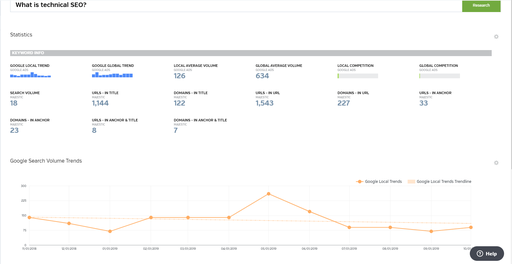
Below is an example of data produced by Ravens software for the keyword ‘What is technical SEO?’.
Conclusion
Congratulations! You’ve got yourself a list of keywords that will allow you to rank for search queries you want to be found for. Now though, the next step is to incorporate your keyword research into your content strategy. By doing this, you will ensure that the content published onto your site is engaging and what your audience wants to hear.
